Sunday, May 31, 2009

Blogging Around

First I went to Kyle's blog. Kyle mentioned that while our blogs are interesting, few people read them

I had the same thought when we started blogging- How many people see this? I put Ads on my blog, and for the whole year, Google owes me... $4.15! That's about 250 page views total.
Maybe if next year's prompts were a bit more open- ended, they could develop into something people would really want to read.


Some passerby did read Mitch's post, which lamented posting on topics that weren't easy to write much about. He posted
ur gay

I responded:
Hey Mitch,

I saw the comment above mine and thought, that just about sums up our blogging experience- being forced to write up a few paragraphs on a topic that has little context for the outside reader, and sometimes little for us, either. Sometimes our prompts make for good posts, but not always.

Wednesday, May 27, 2009

Metacognition: Blogging

I've liked blogs this year!

Grade-wise, they're a double-edged sword- 15 free points is helpful, but 0/ 15 is horribly punitive for forgetting a small assignment- larger than the penalty for a late large assignment.

That said, they're usually fun. Once you make it to the keyboard, there's no pressure, you can just write whatever makes sense. Some of the topics are a bit hard to follow- perhaps for next year, link to an exemplar (from this year) below each topic, if you keep the same ones.

Blogs let me write like I'm talking, and I enjoy that. For the paragraph above, I started with
"Some of the prompts are, like, what?"

I wrote that, and then thought
That's not proper! And it doesn't make as much sense!

So I fixed it.


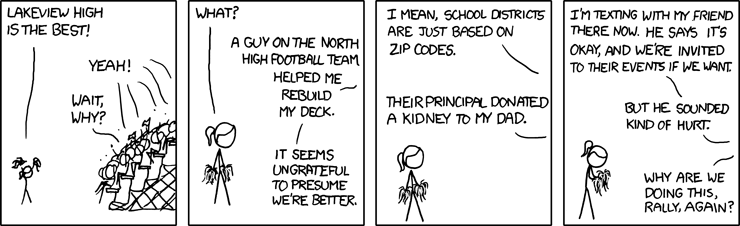
While I'm stuck in a loophole of thinking about what I'm thinking while I'm thinking about what to think, I'll share a cartoon with you all.
You may need to click to see it all.

Friday, May 1, 2009

Metacognition- short story

Editing my story this time around, I had a bit of a challenge. I had to partially rewrite the middle and write an end. Rose and Harold, an older couple, want to pull off a scam to prove they've 'still got it.' I had a bit of a problem- I didn't know what they'd do! If I had a good idea like the one I needed, I'd probably be scamming people, not writing a short story. I went out to dinner with my mom, and, as we were finishing our desert of chocolate lava cake, she suggested, "why don't they steal wine?"

And so they did.

I used the idea of a shop like WineStyles in Northbrook as a model, in a town like Troup, Texas. They used a turquoise van, like the one my family owned until I was about 11. In fact, almost everything I wrote about was based on my experiences.

I wonder where Robert Frost got his inspiration....

Metacognition: Jane Eyre Essay

When I started, I had a bit of trouble picking a group. I knew I'd work with Eli, but I knew that we needed to find a third to fill our group, or we would find ourselves grouped with a certain individual who has trouble wich such group selection.

Albert and I started in the lab. We first took on one topic, because we thought it would be easy. After about two thirds of a page, I thought, 'from where I am now, that topic would be a natural extension of the flow of the dialogue. So, instead of rewriting our initial launch trajectory, we changed targets. (Imagine- NASA's rocket for Saturn messes up at takeoff, so they reroute it to Mars.)

I wrote the discussion's first half, but that was during rehearsals for Cinderella. Eli and Albert took it from there.

Sunday, March 22, 2009

Change of Mind: Jane Eyre

Every time we start a new book, I usually make a quick judgment about how that book will be. For example, I knew King Lear would be hellish. I knew I'd like Life of Pi, etc. When I picked up Jane Eyre from my bookshelf of unused books (it was next to The House on Mango Street and Rules for Writers), I knew that I was in for Lear, round two.

I kept this view untill about chapter 12, when a bit of the language made me stop, and think, 'This is great writing.' It was When Rochester reveals himself as the gypsy. Jane tells him that he was neither himself nor the gypsy woman- he was "some other countenance". I fell in love with the book.
Maybe not the book, but the writing. Charlotte Bronte's style is warmly welcomed into my growing collection.

Literary voices can be likened to the implement that writes them- Life of Pi was like a crayon, and Lear was... a chisel, and Siddhartha, a fine paintbrush, but Jane Eyre is like a exquisite fountain pen, and I'm glad to have it.

Sunday, March 15, 2009

Dialectics: Conflict vs problems

First, this week, my brothers Lee and Phillip are here. In illinois. at my house. With them, there are four of us. four boys, and all three of them take medicines for varying degrees of ADHD, bipolar disorder, and other endless sources of destructive energy. Together in the same room, there's usually always a conflict. In under one hour of playing Xbox, all these conflicts were argued
(loudly):


  • Someone is not a satisfactory teammate. teammate wants to switch partners.

  • someone thinks that their couch space has ben encroached upon. Demands reorginization
  • Someone finishes the ice cream. Someone else did not get to eat any ice cream.

  • Someone claims a territory on the game map. others disagreed. someone kicks someone else


But, there wasn't really a problem behind any of these. just a conflict. The prolem is a group of people that can't handle conflict, and so the conflict escalates. That's a problem.
and so on.

Monday, March 2, 2009

Blogging Around

Brandon,

I did the same thing when I started looking for a story fragment- I looked at the last time I wrote. I found a vocab story from seventh or eight grade that I had liked at the time, and I took about four and a half sentences from it. However, I already had an idea, and that made expanding my fragment a lot easier.


Mitchell,

If I had to, or rather could, choose, I think I would choose the Red. Both world have pain, both have death, and neither is guaranteed to be more 'real' than another. If I stayed here, I'd die just like everyone, eventually. If I left, I might be able to help people, whereas here, all I could do is make someone feel better. I want life to be worth more than a quest for sensory enjoyment. Whether or not it is, i'm sure that I'm not achieving anything great inside the matrix. might as well see the outside.

Kyle:

After i read your blog, two possible instances of "form without meaning" came to mind. First, in 1984 (George Orwell), the people don't have enough words to choose a form- there's only one was to express one idea. They can never say everything they mean.

Also, computers. Computers can't tell if the printer it's connected to is scared or tired or lonely. Computers don't have feelings, so there's no meaning behind any content. There are only facts and instructions.

Sunday, February 22, 2009

Best of Week: Writing a short story

Back in 8th grade, I wrote a few paragraphs about a fictional character- Rose Watkins. The idea came to me in study hall, and I wrote a short page for an assignment. Even now, after two years and three computers, I still have that file. I opened it up to see if I could use it. I was surprised because I had forgotten what my story was like. I eventually ended up keeping just two and a half sentences from the original, but it told the same story, but better.

The story is about Rose Watkins, a sixty-something retired, widowed, and wealthy lady, who realizes one night that she wants to do something more than eat nice dinners before she can't anymore. I'm not sure what she'll do- neither is she. I'm sure it's going to be a lot of fun for both of us.

Anyway, if I was able to take the best part of my old story, I'm looking forward to repeating the process.

Monday, February 16, 2009

What if?: Consumpton Taxes

I read The FairTax Book this weekend (Boortz, Linder), and I have to admit that I like heir idea. I'll summarize:

No income taxes. No capital gains taxes. No Alternative Minimum tax. No corporate taxes. The federal government would fund itself off a 23% national retail sales tax for goods and services, and April 15th becomes "just another spring day." The plan is that not penalizing the highest earners unequally would stimulate the economy, and, above all, keep taxes fair.

What if this actually happened? Support for the bill (HR 25) is limited, but what if it passed?

First, companies that have moved overseas to escape US tax evisceration would come home. With no taxes on gains, everybody with offshore anything- bank accounts, corporate headquarters, manufacturing plants- would come back home. Additionally, America's underground industries - estimated at 1.5 Trillion a year- would be taxed too, every time they went to Wal-Mart or bought a car. And, above all, Americas richest 10% wouldn't be paying, on average, 46% of their gross earnings to the government(with payroll taxes included). Everyone pays 23%. Fairness. Make it happen!

Without the current withholding scheme, everyone's pay would increase. People could invest ALL their earned money, not just the remaining 65%. Then, after the money grows, it's taxed when it's spent. Imagine what that would do for the economy- banks would be stuffed with cash, so interest rates could fall. More people can afford to buy homes. Viola! Housing crisis solved.
People could start a buisiness! Invest in the stock market! US Economy is on the rise!

There's another added benefit that the book didn't address directly, but it also helps the US: 80% of US hundred dollar bills are held overseas. This change would make that money subject to tax again when it's spent. This reality has one obvious effect: the Dollar would drop about 25% compared to other national currencies, in exchange for us having more of them.

There's certainly more that would happen, but I'm not an expert... yet.

Sunday, February 8, 2009

Connection: Heart of Darkness and Slumdog Millionaire

Today I saw Slumdog Millionaire, and it was similar to HoD. In the early section of the movie, in the slums, the children are frequently beaten by... well, anyone, simply because they are slum children. In fact, some Hindus run in to the slum, beating anyone they can with sticks and burning houses(if you can call it that) hecause they dislike the Muslims.

In HoD, the Company's agents comandeer the workforce of the natives, simply because they didn't understand them and thought that they were justified in forcing labor from the locals.

Here in Northbrook, it gets easy to fall into the unconscious belief that this kind of discrimination and poverty doesn't affect us, but seing the same kind of racial violence in a modern setting helped me 'feel' the other, less fortunate souls in the Heart of Darkness

Sunday, December 14, 2008

Blogging around

Jon,

I have to identify with your process. I usually have all of thefollowing, which you mentioned: tea, difficulty turning off music (even when I don't like it), and rampant procrastination. Poetry is difficult without concentration, and concentration is difficult when you have to write poetry =/

Marika,

When I was Writing my poem, i had little difficulty finding an image, but I definitely had trouble putting it to paper. After readig your post, I feel that, even if my poem isn't a masterpiece, the time i spent concentrating on it will definitely help me remember the significance of my image. I just hope I'll be able to get it to the point that everyone who reads it will feel the same way.

Sunday, December 7, 2008

Metacongnition: Poetry

The first thing that comes to mind when i think of poetry is, "do i have to change this?"

I got attached to my first draft, and the second, but now, I'm even more so to my latest. Does that mean i'm improving it, or i'm getting more tired of it?

Also, I used a thesaurus a lot. I found i often had a conundrum- What word do i use, or how do I affect it such that it gives the exaxt meaning or meanings I want it to. It's like words are colurful building blocks, and i want to build a tower, but not have holes or protrusions. It's difficult to say what you mean(not have holes) and mean what you say(not have protrusions) at the same time.

Sunday, November 16, 2008

Connection: King Lear to "The path of stuff"

Today I saw a video on Youtube-"The path of stuff"
The video was a spirited, 20 minute proclamation of the insustainability of the American market... and it was riddled with pitfalls, in the form of half truths. Half-truths that present a true fact, in a way that misrepresent the matter at hand. One example: in the last 40 years, X % of the Earth's original forests have been cut down. Obviously, replanted forests are misrepresenting the impact of corporations. Additionally, her claim that "wal-mart hurts its employees by not proving healthcare" is grounded in fact, but, wal-mart gives people jobs, healthcare or not. There's plenty of people who appreciate the job.

King Lear is filled with deception, half-truth, and not-truth. So many disguises, lies, and more... I realised that the politically-focused loaded argument, and other fallacies of misrepresentation.

Sunday, November 2, 2008

Thoughts on the TED Project

To TED(v.) 1. To use an idea with much potential benefit and execute it poorly ;2. To participate in an Academy-wide project.

This definition sums up the feelings of most of the Academites, myself included.

The TED project succeeded in a few of its objectives:
-Online collaboration worked, simply. I felt as connected as if I was in a room with my groupmates. I thank our choice of Google sites.
-The research and task assignment process was simple and streamlined. Things were assigned, and they got done. The weight for all the students was such that none neglected their duties.

However, the TED presentation fell short, in my opinion, of having overall value. Mostly, research was presented, ideas shared, etc... but these weren't huge, pressing things- they were mostly fairly isolated and separate from our daily life. In all, most, if not all, of what was important in the presentations was already in the videos.

Sunday, October 26, 2008

Captured Thought: Music Piracy and American Law

There's a site that offers access to music online for free. Playlist.com, run by Project Playlist, Inc., claims over 37 Million users... That's a lot. None of them pay a cent for hundreds of thousands of songs. The RIAA, of course, sued back in May. Project Playlist is still running.

The Pirate Bay, a BitTorrent tracker based in sweden, serves over 100,000 daily users, providing access to an enormous amount of free, illegal content. The RIAA, MPAA, and EA games sued. The site still operates.

Both sites defend themselves from the law with one argument: "We don't GIVE them the music." This is true, to an extent. Both sites operate by linking the people with the music to the people who want it, and none of their servers contain illegal content.

Is this piracy on the websites' part? Not techically. Is it illegal? Yes- here's why: Conspiracy. It's the same reason getaway drivers go to jail, even if they didn't steal anything. These sites are instrumental in streamlining mass piracy on an unprecedented scale. (For example, AC/DC's new album, Black Ice, suffers about 10,000 downloads per hour)

So the remaining question is this: How do they get away with it? The answer was suddenly obvious: the numbers game. With the sites' legal protection currently locked in debate, there are just too many people involved. many of them are out of US (and by extension, the RIAA and MPAA) reach. And, to top it off, many have no idea that what they're doing is illegal. Playlist.com is similar in style to iTunes, which is considered legal. Nobody told them they were breaking the law. They just got free music. Facebook and MySpace support the site, and if anything makes a site legit, it's having facebook's endorsement.

So, while the lawyers keep billions of hypothetecal dollars in lockup, the music goes on.

Wednesday, October 22, 2008

iMedia: 100 Years


Today I listened to “100 years”
For some reason, I was especially moved when I heard it... A song not of death, but a song of Life.

Live your life, enjoy it, you’ll only live it once.

When your time comes...

That doesn’t mean go crazy/ do anything; it begs you to understand that someday, tomorrow won’t be guaranteed. Someday, you’ll have to look back, facing the end of your life, and hold yourself accountable for what you made of it. That day, when you’re holding on, fighting for just another moment, clinging to/wishing for just another chance to live, to keep living, to make things right, to make the most of the time you squandered away. Learn now, that one day, you’ll have to defend to your harshest critic your life and what you made of it. Make sure you’re not making decisions today you’ll regret when it all comes together, when you look back….

“Fifteen, there’s still time for you. Time to live and time to choose…”
There’s time to make up, to live a life you’ll be proud of living when your time comes.

Sunday, October 12, 2008

Leanne's blog looked at using words until the meaning fades out of them.


Leanne-
I felt like commenting on your thoughts on swear words.

A while ago, I read 1984, and I thought, "Isn't swearing similar to Newspeak? After all, I would be limiting my expression of a broad range of feelings to what... a dozen four-letter words? I don't think I like the idea.

That's not to say I don't swear at all, but only when the word really IS the right one- that is, I swear about as much as I would use a word like 'magenta,' which is quite specific in meaning.

If I didn't make a point of using the most specific word, these words WOULD lose meaning... So I do.

October 8, 2008 7:00 PM


Melanie pondered the meaning of chocolate.

Hi Melanie!

I think part of the reason chocolate has a special place in society is a simple fact: Cocoa is a DRUG. A stimulant. Cocaine is made from it. Cocaine is highly concentrated and has other additives, but the same stuff that makes chocolate... chocolatey makes illegal drugs. Perhaps more than eating chocolates on valentines', people like getting high.

October 12, 2008 7:04 AM


Sunday, October 5, 2008

359 Degrees: The Economy

First, note that I only claim up to 359 degrees of comprehension (if even that). I'm sure there's something I don't know.

All right. Let's start with the great depression, for history. Essentially, in a decade of economic growth, people developed a novel idea- investing "on margin." The thought was simple: you invest $100, and you can buy $1000 worth of stock. this was wonderful for most, for a time, because if your investment rose 10% (to a value of $1100) you didn't walk away with $110, you got $200! When stocks were going up, up, up, this was great. Many people made a lot of money. Then, the enevitable. Things slowed down. Stocks fell. And people were losing money they didn't have. Everyday people who invested $50 (a significant sum) were responsible for $450(an impossible sum). Some never even knew that this could happen at all, in a time of general ignorance about stocks. Still, corporations were treating leveraged capital like cash. The problem was, there was often no cash behind it. The average investor ended up bankrupt, but the truth was that there still wasn't any way to get the promised money. The rest is history.

In the last few years, the problem was a bit different, but also similar. With houses inflating everywhere, the hypothetical money in home equity was thought to be secure. In fact, investors were told that buying mortgages was a perfect investment. Even if the owner defaulted, the foreclosed house could still be sold, for instant cash. Take the money and buy the new owners mortgage, and you've got a perfect system.
This was true, until something crucial broke: reselling the homes. Due to unrelated economic factors (this is the part I admit ignorance to), demand for homes receded. If an owner declared bankruptcy, 250,000 in a house was just sitting there. the bank owned it, but now, they're not getting that 8% interest rate, and they can't shed the house. Banks that gladly paid cash for the "guaranteed" investment into less-than-qualified homeowners are not finding that the hypothetical money isn't worth dirt.
The Investors who put up the capital for this process find out that more and more of their money owns empty houses paying nothing rather than fat, juicy mortgages, and they pull out and take their money. The Investors decide that 100,000 in a foreclosed house is NOT as good (or better) than cash, and companies like Lehman Bros. find out that what they own doesn't cover what they borrowed to buy it, and when the creditors demand cash, they run out real quick. They promptly fold, and anyone still holding on to their devalued stock finds that their money, as well, isn't worth dirt.

This was one company. The Government doesn't want the great depression, but bigger, so they effectively agree to shoulder the burden of selling the houses, giving investors most, if not all of their "guaranteed" cash.

The hope is that when the houses start selling, the government will get its money back. If all of the sellable houses were to be sold for the prices of five years ago, the Government would actually make a lot of money, used to pay off the national debt.

Let's hope that happens!

Monday, September 29, 2008

How do I think? Hmmm... Let me think....

Well, after giving it some thought, I believe I've isolated my process.

First, a Topic is selected. I must admit that this level goes far beyond my understanding, and even beyond that of the most advanced studies of neurology and neurobiology. The very idea that should have feelings at all, or be concious of myself, goes way, way, way beyond me.

After I've got an area of focus, generally, I isolate factors for change. These are usually "what if?" in nature, such as,"How would that car look in green?" or "If I put an electromagnet near a radio, would I get only static?"
A range of possible results comes quickly, and I apply what I previously knew, things related to the Topic, to rule out some.
Then, a few filters are applied, for things like feasability, side effects, and morality.
In most cases, only one plan for action is decided upon. The process repeats, with the action to be preformed as the Topic. Soon, this derives the result: What do I do right now?

For example, to consider an example question:
Could I get away with not doing my blog entry?

1. Topics involved: Mr. Allen, Blogs, School
2. Area of change: Not doing homework
Possibilities may include:
A world with no homework (Infeasible)
Not doing it, and doing nothing else (Undesirable Side Effects)
"Whacking" Mr. Allen (Unethical, Undisirable Side Effects)
Skipping School (All of the above!)
Doing the post ( Passes QC! )
So, I focus on what it takes to actually do the post, and I end up right here at this little period.

NOW WHAT?

Tuesday, September 23, 2008

Best of Week: Kite Runner

This week, I thought the most interesting thing we did was design the TED project.

When I mentioned to my (non- Academy) friends how we'd collaborated, their immediate reaction was "Did you try to make it really easy, because you're gonna' have to do it?"

I would expect this of them, but it still got me thinking.
I told this anecdote:


There was a man, once, who was standing on the street when a man offered him his choice of $5 or $0.25. The man did not hesitate to select the quarter, and shocked, the second man gave it to him.
The next day, the second man told his co-workers of the fool, and they walked to see if there really was someone so stupid. Invariably, the quarter was chosen. Soon, children, adults, and passers-by would all come and gawk, and reward the man $0.25 for his efforts.
The man was no fool at all. If he had asked for $5, certainly, nobody would have given it to him, and he'd never have got all those quarters!


That's wisdom, right there.

I'm glad we get the opportunity to help design the project. Perhaps not looking forward to it, but if you can't have $5, the quarters are better than nothing.
 
Drug intervention
Drug intervention